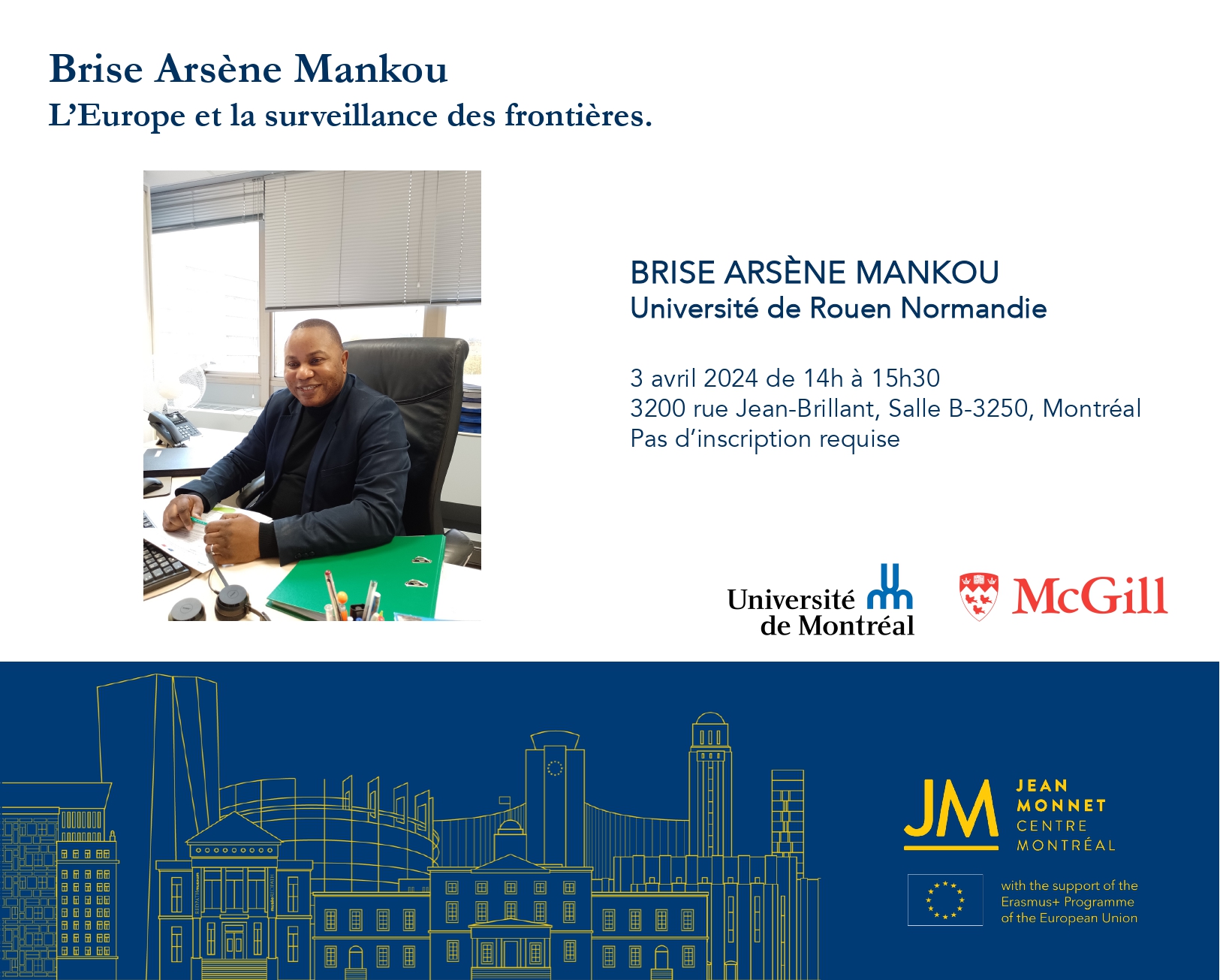
“L’Europe et la surveillance des frontières ”, April 3, 2024, with Brise Arsène Mankou (Université de Rouen Normandie).
Within the premises of the University of Montreal, Brice Arsène Mankou, a professor renowned for his research on the interaction between media and migration, held a conference entitled “Europe and Border Surveillance.” This intervention was part of a partnership with the research center on ethics, shedding light on the tensions between security necessity and respect for human rights in European border management.
Arsène Mankou began by exploring the very notion of borders, considering both their physical and symbolic aspects, and then questioned the surveillance methods employed by Europe. At the heart of the debate was the compatibility of these practices with international human rights standards. The establishment of Frontex, the European Border and Coast Guard Agency, was discussed as the European response to the migration crisis, emphasizing its mission of monitoring and reporting on migrant crossings, mainly from Africa to Italy.
Through the example of the Calais border, described as an “open-air prison,” the speaker illustrated the desperation of migrants seeking to reach the United Kingdom, perceived as an El Dorado. This situation, compared to the contested borders between Israel and Palestine, reveals the extent of humanitarian and security challenges.
The conference also highlighted technological surveillance tools such as visa information systems and systematic border checks, facilitating migrant tracking but raising ethical questions regarding surveillance and the stigmatization of people in motion.
The central issue raised by Arsène Mankou questions the purpose of these technologies: are they serving humanity or are they means of tracking? International law, he reminds us, guarantees fundamental rights to all, including migrants, thus highlighting the dichotomy between border protection and respect for individual freedoms.
The case of Frontex is symptomatic of the dilemmas encountered: despite its crucial role, the agency is often criticized for its inability to effectively reconcile border management with respect for human rights. This situation is all the more poignant because, in circumstances such as the Ukrainian crisis, Europe has shown its capacity to open its borders in a more humane and inclusive manner.
In conclusion, Brice Arsène Mankou calls for a rebalancing between security imperatives and fundamental ethical principles. He emphasizes that while border surveillance falls within state sovereignty, this surveillance must imperatively respect human rights. The conference ends on a hopeful note, mentioning the positive potential of immigration, illustrated by the reception of foreign doctors in certain territories, thus showing that openness can be synonymous with mutual enrichment.
Beyond policies and technical devices, this conference reminds us of the importance of deep reflection on how we perceive others in a world where human mobility is an unavoidable reality, appealing to our collective humanity.
Jérémy Lardry-Cochet.